

IMPORT EXPORT CODE (IEC) REGISTRATION SERVICES
DBIZ CONSULTANCY provides complete Import Export Code (IEC) registration services. From eligibility verification to IEC issuance and compliance guidance, our experts ensure a smooth and hassle-free registration process.
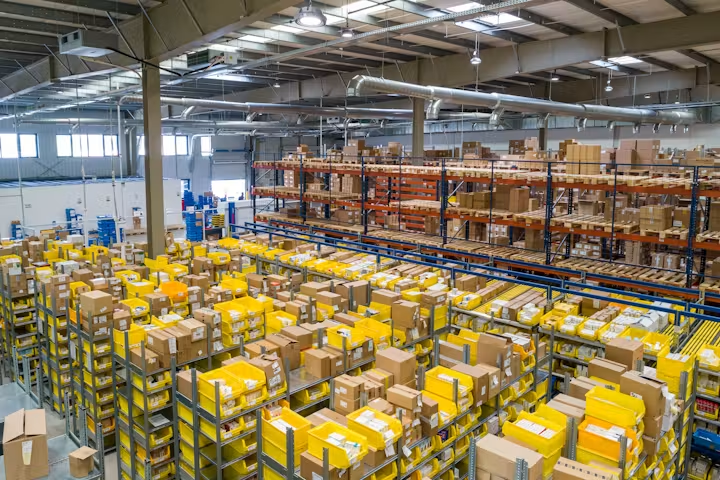
What is Import Export Code (IEC)?
Import Export Code (IEC) is a mandatory registration issued by the Directorate General of Foreign Trade (DGFT) for businesses engaged in import or export of goods and services from India. It establishes the business as a legally recognized entity for international trade.
Upon registration, a unique 10-digit IEC number is allotted, which must be used for customs clearance, international payments, and trade documentation. Without IEC, businesses cannot import or export goods legally.
IEC is a one-time registration with lifetime validity, and annual update is required. It simplifies global trade by enabling businesses to expand beyond domestic markets.
Why IEC Registration is Important
IEC registration is essential for businesses involved in international trade:
Provides legal authorization to import and export goods/services
Required for customs clearance and shipping processes
Enables receiving foreign payments through banks
Helps avail government export incentives and benefits
Builds credibility with international clients and suppliers
Definition as per the Foreign Trade (Development & Regulation) Act, 1992
Section-wise, the DGFT framework defines IEC registration as the process of being legally authorized as an international trade entity:
- Mandatory for Import of Goods into India
- Required for Export of Goods and Services Abroad
- Compulsory for Foreign Currency Transactions via Banks
- Enables Legal Customs Clearance Capability
- Mandatory for E-commerce Cross-Border Selling Platforms
- Required to Avail Government Export Incentives and Schemes
Expert Guidance
Import-Export Services
Legal Framework
IEC registration is governed by the following authorities and laws:
Foreign Trade (Development & Regulation) Act, 1992
Governs import-export activities in India
DGFT (Directorate General of Foreign Trade)
Issues and regulates IEC registration
Customs Act, 1962
Governs import/export clearance procedures
Key Features of Import Export Code (IEC) Registration (Detailed)

Legal Authorization for International Trade
IEC registration provides legal permission to import and export goods or services from India, ensuring compliance with foreign trade regulations.

Unique IEC Allotment
A unique 10-digit Import Export Code is issued by DGFT, which is used for all import-export transactions, customs clearance, and international payments.

One-Time Registration (Annual Update Is Required)
IEC is a one-time registration with no renewal requirement. It remains valid for the lifetime of the business, subject to annual updates if required.
Mandatory for Import & Export Activities
IEC is compulsory for clearing goods through customs, sending shipments abroad, and receiving goods from foreign countries.

Facilitates International Payments
Banks require IEC for processing foreign currency transactions, remittances, and export proceeds, making it essential for global trade.

Access to Government Benefits & Incentives
IEC holders can avail various export promotion schemes, subsidies, and incentives provided by the Government of India.

No Compliance Burden
Unlike GST, IEC does not require regular return filing. There are minimal compliance requirements after registration.

Global Market Expansion
IEC enables businesses to expand beyond domestic markets and access international customers and suppliers.

Applicable to All Business Types
IEC can be obtained by individuals, proprietorships, partnerships, LLPs, and companies engaged in import-export activities.

Enhances Business Credibility
Having IEC increases trust among international clients, suppliers, and financial institutions, supporting global business relationships.
Categorized Advantages
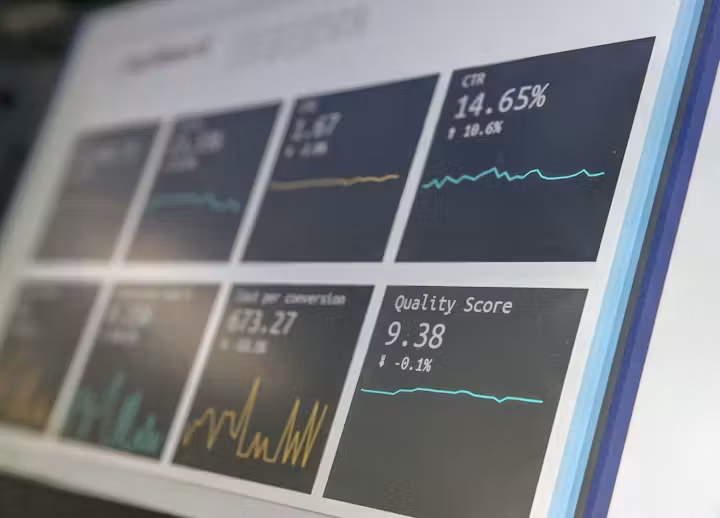
Scale your business across international borders with ease.
Business Advantages
Business Advantages
- • Legal authorization to import and export goods/services
- • Improved credibility with international clients and suppliers
- • Smooth customs clearance and trade operations
- • Eligibility to participate in global trade and contracts
Financial Advantages
- • Enables receipt of foreign currency payments through banks
- • Access to export incentives, subsidies, and government schemes
- • Better financial transparency in international transactions
- • Supports growth in foreign revenue generation
Growth Opportunities
- • Expansion into international markets
- • Access to global customers and suppliers
- • Opportunity to sell through global e-commerce platforms
- • Increased scalability and business diversification
4. When IEC Registration is Mandatory
| Condition | Requirement | Description |
|---|---|---|
| Import of Goods | Mandatory | Any business or individual importing goods into India must obtain IEC for customs clearance. |
| Export of Goods | Mandatory | IEC is required to export goods from India and complete shipping and customs procedures. |
| Foreign Currency Transactions | Mandatory | Required for receiving payments in foreign currency through banks for export services or goods. |
| Online International Selling | Mandatory | Businesses selling products on global platforms (Amazon Global, eBay, etc.) require IEC. |
| Availing Export Benefits | Mandatory | Required to claim government export incentives, subsidies, and benefits under DGFT schemes. |
Types of IEC Registration
| Type | Suitable For | Description |
|---|---|---|
| Individual IEC | Individuals / Freelancers | For individuals engaged in import-export activities such as freelancers, consultants, or small traders. |
| Proprietorship IEC | Small Business Owners | For sole proprietors dealing in import-export of goods or services. |
| Partnership / LLP IEC | Partnership Firms / LLPs | For businesses operating as partnership firms or LLPs involved in international trade. |
| Company IEC | Private / Public Companies | For registered companies engaged in large-scale import-export activities. |
Structured Document Lists
For Individual / Proprietor
- PAN Card (Mandatory)
- Aadhaar Card for verification
- Recent passport-sized photograph
- Bank account details (cancelled cheque / bank certificate)
- Address proof (Aadhaar / utility bill / bank statement)

For Company / LLP
- Certificate of Incorporation / Registration
- PAN Card of Company / LLP
- MOA & AOA / LLP Agreement
- Directors’ / Partners’ KYC documents (PAN, Aadhaar, address proof)

For Registered Office Proof
- Rent Agreement + NOC from owner (if rented)
- Latest Electricity / Utility Bill (within 2 months)
- Ownership proof (if property is owned)
Documentation Guidelines
Standard protocols for successful IEC registration.
| Task / Guideline | Filing Protocol |
|---|---|
Detail Verification | Verify all details carefully before submission. Name and particulars must match across all documents especially PAN and Aadhaar. |
Office Consistency | The registered office address must exactly match address proof and ownership documents provided in the application. |
Rent Agreement | If premises are rented, a valid rent agreement with matching owner and tenant details is mandatory along with NOC. |
Active Bank Account | The bank account provided must be active and in the name of the applicant/business entity. |
Address Proof Recent | Utility bills or bank statements used as address proof should strictly be within the last two months. |
Data Validation | Ensure mobile and email are active for OTP verification during the registration process on DGFT portal. |
Note: Even minute discrepancies in data can lead to application query or rejection by DGFT.
Step-by-Step Detailed Guide
Step 1: Data Collection & Verification
The process begins with collecting all required business and KYC details. All documents are carefully verified to ensure accuracy and consistency.
Step 2: Creation of DGFT Login
The applicant visits the DGFT portal, enters basic details (PAN, mobile, email), and completes OTP verification to create secure login credentials.
Step 3: Filling IEC Application
Using the DGFT login, the full application is completed including Business Details, Bank accounts, and uploading forms.
Step 4: Aadhaar Authentication
Opting for Aadhaar authentication generates OTP. If successful, ensures significantly faster approval. If not, Digital Signature (DSC) is required.
Step 5: Application Submission
Digital submission using EVC for proprietors or DSC for companies. An application reference number is generated instantly for tracking.
Step 6: DGFT Verification
The system reviews the application. If clarification is needed, a query is issued. Proper response must be filed quickly to avoid delays.
Step 7: IEC Allotment & Cert Issue
Once approved, the unique 10-digit IEC is activated. The IEC Certificate is generated and available for download indicating full trade authority.
Step 1: Data Collection & Verification
The process begins with collecting all required business and KYC details. All documents are carefully verified to ensure accuracy and consistency.
Step 2: Creation of DGFT Login
The applicant visits the DGFT portal, enters basic details (PAN, mobile, email), and completes OTP verification to create secure login credentials.
Step 3: Filling IEC Application
Using the DGFT login, the full application is completed including Business Details, Bank accounts, and uploading forms.
Step 4: Aadhaar Authentication
Opting for Aadhaar authentication generates OTP. If successful, ensures significantly faster approval. If not, Digital Signature (DSC) is required.
Step 5: Application Submission
Digital submission using EVC for proprietors or DSC for companies. An application reference number is generated instantly for tracking.
Step 6: DGFT Verification
The system reviews the application. If clarification is needed, a query is issued. Proper response must be filed quickly to avoid delays.
Step 7: IEC Allotment & Cert Issue
Once approved, the unique 10-digit IEC is activated. The IEC Certificate is generated and available for download indicating full trade authority.
7. TIMELINE & DELIVERY
Application Filing
Collection of applicant details, document verification, and submission of IEC application on the DGFT portal.
Processing
System processing along with Aadhaar / DSC verification and validation of submitted details.
Approval (Normal Case)
IEC number is issued if all details are correct and verification is completed successfully.
Approval (With Query / Correction)
Time may increase if DGFT raises queries or requires clarification or correction.
Quick Summary
Fast Track Approval
Typical timeframe for IEC issuance with correct documentation and active Aadhaar verification.
Delayed Cases
Applies when DGFT raises queries or clarification is required in the submitted application.
Note: Accurate documents and correct details ensure faster IEC approval without delays.
8. Post-Registration Compliance
Once registered, your business must maintain these mandatory filing cycles to remain legally active and avoid deactivation or penalties by DGFT.
Annual Update
Once a year (April - June)
Trade Reporting
Based on export activities
Essential
Compliance Requirements
Caution
Legal Penalties
IEC deactivation by DGFT
Suspension of trade license
Hefty fines & legal restrictions
9. Why DBIZ CONSULTANCY
for IEC Registration?
Obtaining an Import Export Code (IEC) is a crucial step for businesses planning to enter international markets. While the process is online and appears simple, errors in documentation, incorrect details, or improper filing can lead to rejection or delays in approval. That’s where DBIZ CONSULTANCY comes in.
What DBIZ Handles
- IEC eligibility assessment based on your business activity
- Document validation and pre-upload review back to avoid rejection
- DGFT portal registration and IEC application filing
- Aadhaar / DSC authentication support
- Application submission and fee payment guidance
- Continuous status tracking and follow-up
- Handling DGFT queries and corrections (if required)
- IEC certificate download and delivery
- Post-registration guidance and compliance support
What You Provide
- PAN and Aadhaar of applicant / business
- Business details and nature of import-export activity
- Registered office address proof (rent agreement / ownership proof)
- Bank account details (cancelled cheque / statement)
- Photograph (if applicable)
When Should You Apply?
Identify the key milestones that trigger the need for immediate IEC registration.
Starting an import-export business
Planning to sell goods or services internationally
Receiving foreign currency payments
Expanding business to global markets
Required for customs clearance or trade documentation
To avail export incentives and government schemes
Why Choose DBIZ CONSULTANCY?
IEC registration is not just about obtaining a code—it is about ensuring smooth international trade operations and compliance with DGFT regulations.
Timelines
IEC Deadlines & Compliance
Annual Update
April – June (Every Year)
Mandatory annual update of IEC details on DGFT portal to keep the code active.
Initial Allotment
Same Day
IEC number is typically issued instantly after successful Aadhaar/DSC verification.
Query Response
Immediate
Response to DGFT queries must be filed promptly to ensure quick approval.
Profile Modification
As Needed
Updates to bank details or address should be done immediately after changes.
Legal Risks
Penalties & Consequences
Failure to update IEC annually leads to automatic deactivation on the DGFT portal.
Import and export activities are suspended while the IEC is inactive or deactivated.
Inability to claim export incentives or subsidies if IEC compliance is not maintained.
Incorrect or inactive IEC leads to significant delays and storage costs at customs ports.
Our Commitment
With strong experience in business registrations and compliance services, DBIZ CONSULTANCY is a trusted partner for businesses entering global markets. We handle the entire IEC process—so you can focus on expanding your business internationally with confidence.
FAQs on IEC Registration
Last updated: March 2026
Whether you're planning to start import-export, understanding IEC applicability, or exploring international trade — here are the most commonly asked questions with clear and practical answers.